HANA Calculation Views vs SQL — Why Migrate Now (And How to Do It)
March 21, 2026
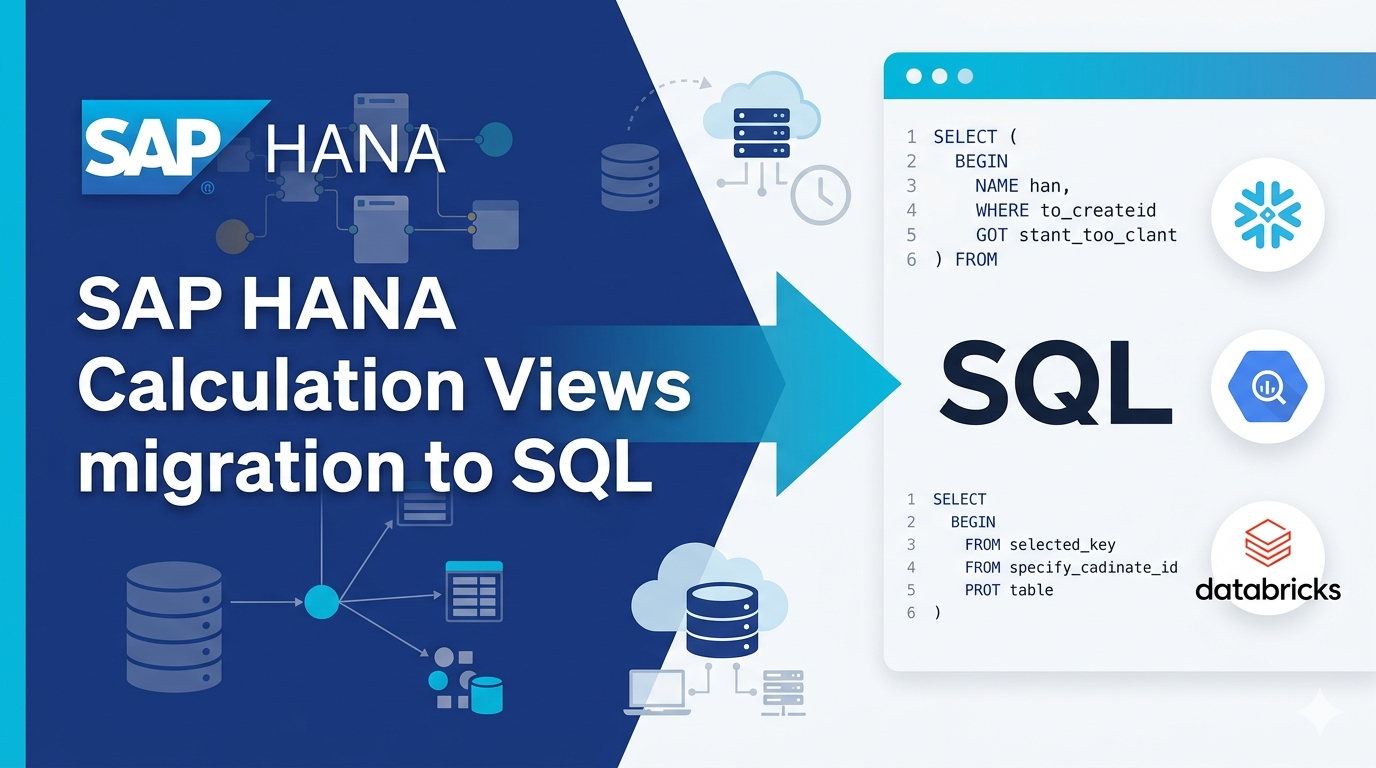
Introduction: The Ticking Clock on Legacy Logic
Imagine your data engineering team spending three weeks trying to trace a single KPI discrepancy across 15 nested graphical calculation views. Now, multiply that inefficiency across your entire enterprise.
As the December 31, 2027 deadline for SAP ECC and SAP BW 7.5 mainstream maintenance approaches, organizations are facing a harsh reality: keeping complex business logic locked inside on-premise or legacy SAP ecosystems is no longer a sustainable strategy.
While SAP HANA Calculation Views have been the undisputed heavyweights of multidimensional modeling for the past decade, the center of gravity in enterprise data has shifted. The modern data stack demands the infinite scale and interoperability of native cloud platforms like Google BigQuery, Snowflake, and Databricks. Converting your graphical Calculation Views to standard SQL or PySpark isn't just an IT upgrade; it is the definitive move to future-proof your analytics.
Key Takeaways
- The Deadline is Real: SAP mainstream support for BW 7.5 and core ECC ends in 2027, making migration planning urgent.
- Scalability & Cost: Cloud data warehouses offer superior, elastic compute compared to HANA's strict in-memory hardware constraints.
- SQL is the Standard: Standardizing on SQL or PySpark unlocks modern CI/CD practices (like dbt) and access to a massive global talent pool.
- Automation is the Only Way: Manual rewrites take months and are highly error-prone. Automated parsing engines can convert XML definitions to target-optimized SQL or PySpark in seconds.
What Are HANA Calculation Views?
For the uninitiated, SAP HANA Calculation Views (CVs) are virtually constructed data foundation models. They serve as a powerful semantic layer, allowing developers to create complex data models with advanced logic—star joins, unions, aggregations, calculated columns, and currency conversions—without replicating the underlying data.
Traditionally, these views come in two main flavors:
- Graphical Calculation Views: Built using a drag-and-drop interface in SAP HANA Studio or Web IDE. They visually represent the data flow through various nodes, stored under the hood as complex XML files.
- Scripted Calculation Views: Built using SQLScript (though SAP has largely deprecated these in favor of Table Functions).
Ten years ago, graphical CVs were revolutionary. They brought processing logic down to the database layer (the "code-to-data" paradigm), enabling blazingly fast analytics on massive ERP datasets.
The Limitations of Calculation Views in 2026
While brilliant for their time, Calculation Views present significant bottlenecks in a modern, cloud-first data architecture.
1. The Complexity & Maintenance Trap
Over the years, graphical CVs often devolve into tangled "spaghetti" models. Debugging performance issues across deeply nested views is a nightmare.
2. The Integration Wall
When migrating KPIs from SAP and non-SAP systems to the Google Cloud Platform (GCP) or AWS, legacy graphical views act as a massive integration wall. While you can connect visualization tools via ODBC/JDBC, advanced data transformations using modern tools like dbt (data build tool) or Python-based ML frameworks are severely constrained by the proprietary SAP logic.
3. Talent Scarcity
Finding developers skilled in niche HANA graphical modeling is increasingly difficult and expensive. The broader data engineering market has converged entirely on SQL and Python.
4. Scalability & Performance Ceilings
HANA's in-memory model is incredibly fast but bound to your provisioned hardware. Scaling up requires expensive infrastructure investments. Furthermore, outside of the HANA engine, query optimization is limited. Cloud data warehouses offer advanced, decoupled query optimization techniques that legacy on-premise systems simply cannot match.
💡 Ready to see your Calculation Views in standard SQL?
Try HANACV2SQL for Free Today — No credit card required.Why SQL is the Universal Language of Data
The solution to the Calculation View dilemma is a return to basics: standard SQL. SQL has unequivocally won the data language war. Transitioning your CVs to standard SQL offers profound advantages:
- Engineering Best Practices: SQL code is inherently transparent. It can be version-controlled in Git, peer-reviewed, and integrated seamlessly into CI/CD pipelines.
- Massive Talent Pool: You can easily staff your data engineering teams without searching for expensive, hyper-specific SAP skill sets.
- Universal Interoperability: Standard SQL works flawlessly with every modern BI tool, machine learning framework, and reverse-ETL data pipeline on the market.
The Business Case for Migration
Migrating Calculation Views to cloud-native SQL is a massive cost-saving measure that directly impacts the bottom line.
- Dramatically Lower TCO: SAP HANA hardware and licensing costs are notoriously high. Cloud data warehouses operate on a pay-per-query or pay-per-compute model, slashing operational costs.
- Agility & Self-Serve Analytics: Enabling SQL on platforms like BigQuery or Databricks democratizes data access, fostering true self-serve analytics across the enterprise.
- Risk Mitigation: The 2027 maintenance deadline is practically tomorrow in enterprise timelines. Proactively moving your logic to an agnostic format de-risks your future ERP roadmap.
What to Expect During the Migration Process
Migrating your logic isn't just about rewriting code; it requires rigorous validation. A successful migration involves:
- Code Conversion: Translating the proprietary XML logic into SQL.
- Performance Benchmarking: Testing the new SQL queries in your target cloud environment to ensure they leverage Massively Parallel Processing (MPP) effectively.
- Data Validation: Running side-by-side comparisons of the legacy CV output and the new SQL output to guarantee 100% data fidelity.
How to Migrate — The Options
If you are convinced that migrating to SQL is the right move, how do you actually execute it?
1. Manual Rewrite
Having developers manually read the graphical CV in HANA Studio and translate it into SQL. This is agonizingly slow, highly prone to human error, and costs a fortune.
2. Consulting Firms
Hiring system integrators (SIs) to manage the project. This is often prohibitively expensive and typically just masks a manual offshore rewrite process.
3. Automated SaaS Tools (The Smart Choice)
Using purpose-built platforms like HANACV2SQL.
Our tool handles the heavy lifting through a rigorous, automated two-part process. First, our parsing engine instantly converts the complex HANA CV XML file into standard SQL or PySpark. Then, our advanced SQL Mapping Engine generates target-optimized syntax tailored specifically for your destination platform—whether that's Snowflake, BigQuery, Databricks, or Redshift.
Call To Action
Don't let legacy data modeling become the anchor holding back your cloud transformation.
Try HANACV2SQL today. Experience the magic of automated conversion, risk-free. You can convert your first Calculation View to optimized, cloud-ready SQL or PySpark in under 30 seconds.
FAQ
When is the SAP BW 7.5 end-of-life deadline?
Mainstream maintenance for SAP BW 7.5 and core SAP ECC 6.0 ends on December 31, 2027. Extended maintenance is available until 2030, but comes with premium fee increases.
Can I export HANA Calculation Views directly to SQL or PySpark?
SAP does not provide a native one-click tool to convert complex graphical Calculation Views into target-agnostic SQL or PySpark. Migrations traditionally require manual rewrites or third-party automated parsing tools like HANACV2SQL.
Why migrate SAP data to BigQuery or Snowflake?
Migrating off proprietary SAP HANA views to platforms like BigQuery or Snowflake reduces vendor lock-in, significantly lowers total cost of ownership (TCO) through elastic computing, and allows your data to integrate natively with modern tools like dbt and Python-based AI frameworks.